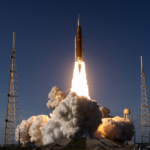
There are moments in spaceflight where all the engineering, all the delays, all the politics fade into the background—and what’s left is something much simpler: people looking up.
That’s exactly what played out at Kennedy Space Center as crowds gathered for the Artemis II launch, a mission that marks NASA’s return to sending humans around the moon for the first time in decades. Among them was a young boy who had made the trip to Titusville, Florida, not just to watch, but to capture it. GoPro strapped to his NASA cap, he stood waiting, ready to record something he clearly understood was bigger than an ordinary day.
When a reporter asked why he came—why it mattered to be there in person—his answer cut through everything.
“We’re going back to the frickin’ moon, that’s why!”
It’s the kind of line that sticks, not because it’s polished, but because it isn’t. It captures the raw excitement that’s easy to lose in technical briefings and mission timelines.
And this mission carries weight.
Artemis II launched just after 6:30 p.m. Wednesday, sending a four-person crew—three Americans and one Canadian—on a 10-day journey that will take them roughly 685,000 miles through space, looping around the moon before returning to Earth. It’s not a landing mission, but it’s a critical step toward putting humans back on the lunar surface.
🚨 BOOM! This kid just dropped STRAIGHT FIRE on CNN ahead of Artemis II launch
“Why do you want to be here?”
KID: “We’re going back to the FRICKIN’ MOON, that’s why!” 🔥🇺🇸
History being made! pic.twitter.com/Ws5TyZP1U6
— Eric Daugherty (@EricLDaugh) April 1, 2026
The timeline is precise. About four days to reach the moon, a carefully calculated arc around it, and then the return. Every phase builds on systems that will eventually support longer missions and, ultimately, sustained presence.
Even the launch itself, while largely smooth, carried the usual last-minute tension. Engineers flagged a temperature issue in one of the Launch Abort Systems just 19 minutes before the window opened. The kind of detail that could delay everything—until it didn’t. The problem was resolved, systems flipped back to “Go,” and the countdown held.
Nine minutes after liftoff, Artemis II was in orbit.
From there, the mission becomes quieter, more distant, measured in telemetry and course corrections rather than fire and sound. But on the ground, in that moment of ignition, none of that subtlety matters.
What matters is what that kid said—because it’s the simplest possible summary of a very complicated achievement.
After years of planning, setbacks, and recalibration, the United States isn’t talking about returning to the moon anymore.
It just did the next step toward it.