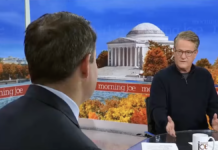
The debate surrounding the SAVE America Act has intensified, with sharply contrasting interpretations emerging from lawmakers and commentators. During a recent appearance on MS NOW’s “All In,” Sen. Raphael Warnock (D-GA) offered a forceful critique of both the legislation and the broader political context in which it is being advanced.
Warnock framed the bill not as a standard election integrity measure, but as a mechanism that could significantly alter control over voter registration systems. He argued that, rather than focusing on identification requirements alone, the legislation risks expanding federal influence over state-managed voter rolls.
In his view, that shift represents a fundamental change in how elections are administered, raising concerns about the balance of authority between federal and state governments.
His criticism extended beyond the bill itself to a broader assessment of the current administration’s political standing. Warnock suggested that recent policy outcomes—ranging from economic pressures to foreign policy developments—are shaping voter sentiment in ways that could influence upcoming elections.
Within that context, he characterized the SAVE Act as part of a larger political strategy rather than a narrowly tailored policy response.
A key element of Warnock’s argument is his distinction between voter ID requirements and the provisions within the SAVE Act. While acknowledging that verifying voter identity can be a reasonable component of election administration, he contended that this legislation goes further.
According to his interpretation, it introduces mechanisms that could lead to the removal of eligible voters from registration rolls, particularly if administrative errors or documentation issues arise.
Supporters of the bill, by contrast, argue that it is designed to strengthen election integrity and ensure that only eligible citizens participate in federal elections. They maintain that safeguards are necessary to maintain public confidence in the electoral system, and that federal standards can help create consistency across states.
As the legislation continues to move through Congress, the intensity of the rhetoric surrounding it suggests that the debate is unlikely to settle into consensus. Instead, it remains a focal point in a broader struggle over the rules, structures, and safeguards that define American elections.