The temperature around President Trump’s rhetoric on Iran didn’t just rise—it snapped into open political combat almost instantly.
It started with Trump’s own words. In a Truth Social post on Easter Sunday, he laid out what sounded less like a warning and more like a timeline, referencing potential strikes on Iranian power plants and bridges while issuing a direct threat tied to the Strait of Hormuz. The language was blunt, aggressive, and impossible to misinterpret.
By Monday, the response from Democratic lawmakers was immediate and pointed.
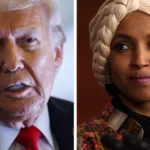
Rep. Ilhan Omar didn’t hedge. She labeled Trump an “unhinged lunatic” and went straight to the most extreme remedies available under the Constitution—invoking the 25th Amendment, impeachment, and removal from office. There was no attempt to soften the language or reframe it as policy disagreement. This was escalation, direct and personal.
In the Senate, the tone shifted slightly but not the underlying concern.
Sen. Mark Kelly focused on the substance of the threat itself, zeroing in on the mention of civilian infrastructure. His warning wasn’t about rhetoric—it was about consequences. Targeting power plants and bridges without a clear military justification, he argued, could cross into violations of the laws of armed conflict. That’s not political messaging; that’s a line drawn around legality and military conduct.
Sen. Jeff Merkley pushed even further, explicitly raising the possibility of war crimes and directing his comments not just at Trump, but at military leadership. His message carried a specific instruction: unlawful orders are not to be followed. That’s a rare move—when elected officials start speaking past the president to the chain of command, it signals a deeper level of alarm.
Then came Sen. Bernie Sanders, who stripped it down to its bluntest form, calling Trump’s comments “dangerous” and “mentally unbalanced,” while urging Congress to act immediately to end the conflict.
And through all of it, Trump didn’t pull back. If anything, he doubled down during remarks on Monday, describing a scenario where Iranian infrastructure could be “completely demolished” within a set timeframe—before adding, almost as an aside, “We don’t want that to happen.”
That contrast—laying out destruction in vivid terms, then disclaiming it—has become a defining feature of moments like this. It leaves room for multiple interpretations: deterrence, negotiation pressure, or something more literal.
What’s clear is how quickly the reaction formed. Within hours, the conversation moved from foreign policy to constitutional remedies, from military strategy to questions about legality and command responsibility.
At that point, it’s no longer just about Iran. It’s about how far rhetoric can go before it triggers consequences at home.