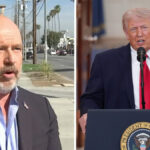
The California governor’s race shifted the moment Donald Trump stepped in with a full endorsement of Steve Hilton, injecting national political weight into what was already a crowded and competitive primary.
Trump’s statement did more than signal preference — it framed the race in stark terms, tying Hilton’s candidacy directly to his broader critique of California’s current leadership. By casting the state as in decline and positioning Hilton as the candidate to reverse that trajectory, Trump effectively nationalized the contest, turning it into a proxy fight over direction as much as leadership.
For Hilton, the endorsement delivers immediate advantages. In a state where Republican candidates often struggle to consolidate support early, backing from Trump provides instant visibility, fundraising leverage, and a clearer lane within the GOP field. Hilton was already among the more recognizable Republican candidates due to his media presence, but this endorsement elevates him from contender to focal point.
That shift has consequences for the rest of the field, particularly Riverside County Sheriff Chad Bianco, who had been competing with Hilton for the same bloc of voters. In a top-two primary system, where all candidates compete on the same ballot regardless of party, splitting the vote can be as decisive as winning it. Consolidation behind one Republican candidate changes the math.
Some analysts argue that this consolidation may actually reduce the chances of two Republicans advancing to the general election. If Democratic candidates maintain broader but divided support across multiple contenders, a single dominant Republican could take one slot while the second goes to a Democrat. Without that consolidation, there had been a narrower path — however unlikely — for two Republicans to edge into the top two.
The Democratic side remains fragmented as well, with multiple high-profile names in contention, including Xavier Becerra, Eric Swalwell, and Antonio Villaraigosa. Their positioning will matter just as much as Republican alignment in determining who advances.
The timing is also notable. With the primary set for June 2, 2026, endorsements at this stage shape donor behavior and campaign strategy early enough to have lasting effects. Trump’s backing is likely to influence not just voters, but where outside groups and political action committees decide to invest.
Hilton’s recent move to formalize his American political identity — becoming a U.S. citizen in 2021 and renouncing his U.K. citizenship in 2025 — adds another dimension to his candidacy, reinforcing his positioning as fully committed to the race at a moment when national attention is increasing.
What was already a competitive primary now has a clearer center of gravity on the Republican side. Whether that strengthens or limits the party’s chances in California’s top-two system is no longer theoretical — it will play out directly in the months ahead.