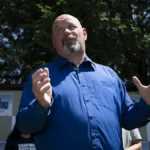
Massachusetts Governor Maura Healey has joined a chorus of Democratic state executives loudly denouncing Texas Governor Greg Abbott’s call for a special legislative session — one that could bring about an unusual mid-decade redistricting in the Lone Star State.
Abbott, with the encouragement of President Donald Trump, argues that Texas’s current maps give Democrats a share of House seats disproportionate to the state’s overall Republican tilt.
Healey, speaking in the language of tit-for-tat politics, suggested that Democratic states might need to answer in kind. “Donald Trump, Greg Abbott, Ken Paxton have left us no choice,” she said, adding that she and her fellow governors want their constituents “represented” and “voices heard, whether you vote for me or not.” Yet the Massachusetts governor’s position carried an unmissable irony: her own state sends nine Democrats and zero Republicans to Congress, leaving no opposition seats to “target” in any retaliatory reshuffle.
Democrat Governor Threatens to Gerrymander but Forgets THIS About Massachusetts… pic.twitter.com/WU9ZkKNiBu
— Breitbart News (@BreitbartNews) August 7, 2025
The contradiction in Healey’s rhetoric was as much about mechanics as it was about principle. She condemned Texas Republicans for allegedly seeking to “completely rewrite a map out of nowhere to take away the votes and the voices of Texans” — even as she entertained the possibility of mid-decade redistricting in her own state, a process she framed as protecting representation.
The suggestion that Massachusetts could “retaliate” against Texas in the absence of any GOP-held districts underscored the symbolic nature of her warning.
The numbers themselves tell the rest of the story. Texas currently sends 25 Republicans and 12 Democrats to the House, with a 13th Democratic seat now vacant. The proposed redraw could shift as many as five districts toward the GOP, resulting in a 30-to-8 split — still more balanced than Massachusetts’ complete Democratic sweep.
Healey’s closing line — “We’re going to follow the rules” — left open questions about which rules she meant, and how flexibly she might interpret them in pursuit of partisan goals.
Her inclusion among governors like Gavin Newsom, JB Pritzker, and Kathy Hochul suggested a coordinated political message rather than an imminent change in Massachusetts’ congressional lines.