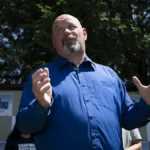
Former Obama White House chief of staff Rahm Emanuel delivered a blunt message to Democratic Socialists on Sunday: If they believe voters want their agenda, they should run on it as a separate party rather than attempt to take over the Democratic Party.
Emanuel made the argument during an appearance on “Fox News Sunday” after host Shannon Bream raised criticism from Sen. Bernie Sanders and the growing fight over the Democratic Party’s direction.
Bream quoted Sanders as saying, “People are sick and tired of the Rahm Emanuels,” before asking Emanuel about claims that the party’s political energy is moving away from establishment figures and toward socialism.
Emanuel rejected that premise and drew a sharp distinction between Democratic Socialists and Democrats.
“Well, here’s the thing. I don’t consider Democratic Socialists part of the Democratic Party,” Emanuel said.
He pointed to a recent Democratic Socialists convention in Chicago and described the organization as a “separate party.” Emanuel then listed positions he associates with Democratic Socialists, including defunding police departments, releasing prisoners, opening the border and eliminating the Pentagon.
His challenge was straightforward.
“If you’re so confident people want that, I’ll see you in November,” Emanuel said. “Put it on the ballot. Let’s go run as a separate party. The Democratic Party is not open to be taken over.”
Emanuel did, however, acknowledge significant ideological differences within the Democratic Party itself. He described those divisions as a progressive wing on one side and a pragmatic wing on the other, arguing that both can agree that working- and middle-class Americans face serious economic problems.
The real argument, he said, should be about how Democrats address those problems.
Emanuel specifically cited the ability to buy a home, save for retirement, pay for children’s education and obtain health care without financial turmoil as issues around which Democrats should construct their agenda.
He also gave progressives credit for putting forward policy ideas, even when he disagrees with them.
“They have been out there with ideas,” Emanuel said. “Some I agree, some I disagree with.”
But Emanuel argued that the party’s pragmatic wing needs to respond with its own concrete proposals. Among the policies he mentioned were improving education, prohibiting people over 75 from holding public office across all three branches of government, banning social media for children under 16 and investing in energy infrastructure.
Emanuel then reached into recent Democratic history to make his larger electoral argument.
He praised former Presidents Bill Clinton and Barack Obama, both of whom he worked with, as well as former House Speaker Nancy Pelosi. Emanuel argued that Democrats have historically enacted major policies not simply by piling up votes in overwhelmingly Democratic areas, but by competing successfully in Republican territory.
“There’s no way you’re going to get there turning a blue district to midnight blue,” Emanuel said. “You got to do it by flipping red districts to blue, winning red states and turning them blue. That is how it happens.”
He cited former Nebraska Sen. Ben Nelson as an example, noting that the Democrat from a conservative state supplied a crucial vote for the Affordable Care Act. Emanuel also pointed to former West Virginia Sen. Joe Manchin and his role in passing the Inflation Reduction Act during the Biden administration.
For Emanuel, those examples demonstrate the practical importance of maintaining a Democratic coalition capable of winning outside safely liberal jurisdictions.
He argued that presidential elections make the same point. According to Emanuel, roughly 500,000 voters spread across seven states determined the outcome of the last three presidential elections.
That leaves Democrats with a mathematical problem as much as an ideological one: They need independent and persuadable voters in competitive states.
“You’ve got to win in areas that are not safe blue areas, but persuade independent voters to come and find alignment with the Democratic Party,” Emanuel said.
The discussion also provided another hint about Emanuel’s own political future. While stopping short of announcing a campaign, he again raised the possibility that he could run for office.
“If I decide to run, I’m not a peacetime consigliere,” Emanuel said. “I’m a wartime general.”